


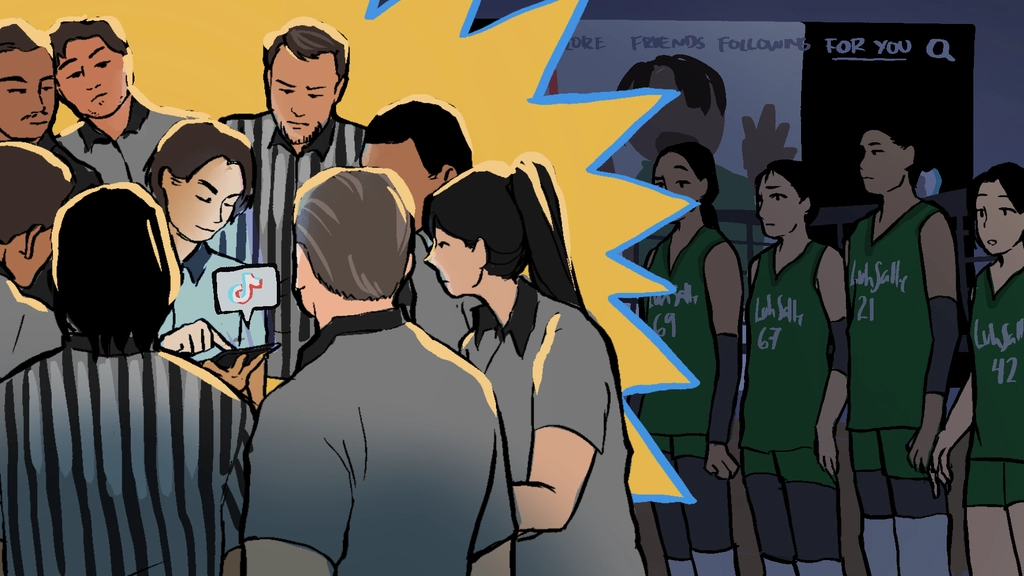
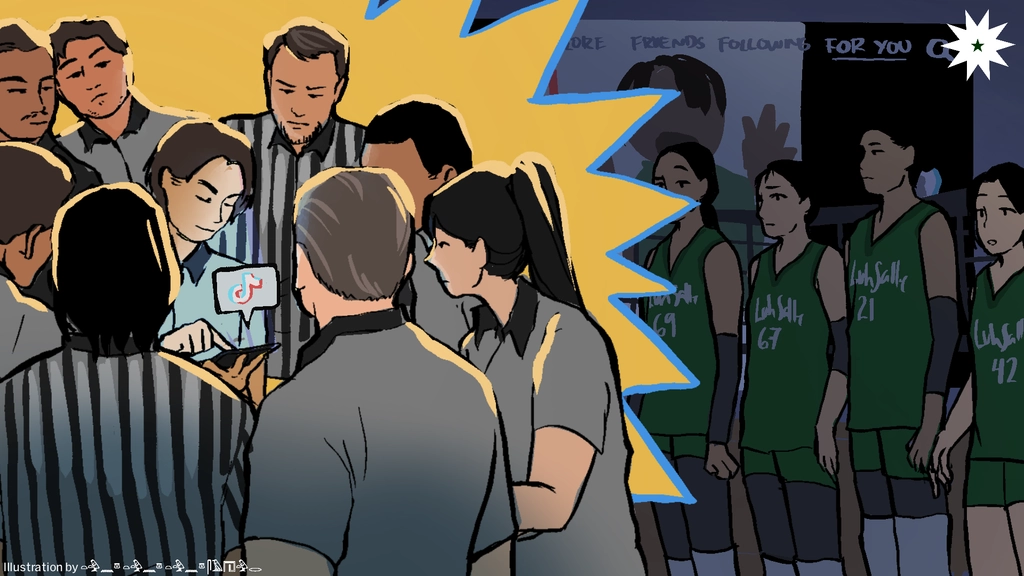
In a bold move to “modernize officiating” and cater to the demands of the league’s fans, UAAP referees have officially replaced replay monitors with TikTok, turning every close call into a brainrotted doomscroll.
Under the new system, when coaches challenge a call, referees are prompted to get their cellphones, open TikTok, and search the game’s hashtag. The final decision is based on whichever video has the clearest angle, best song to match the edit, or simply the most likes.
Enhanced angles
During the DLSU Lady Spikers’ recent matchup against the UST Golden Tigresses, a down-the-line attack from outside hitter Angel Canino was called out by the line judge, immediately sparking a disagreement on court as the Taft-based squad insisted the ball clearly clipped the line. What should have been a quick review turned into a full-blown debate session between the referees, as play was stopped for nearly five minutes while they refreshed the For You page.
“Wait lang… mas malinaw pa ‘yung edit kanina…’yung may maraming effects,” one referee insisted. Another ref reportedly chimed in, “Ay ito maganda, may zoom, ‘tsaka malungkot ‘yung kanta.”
(Wait… the previous edit was clearer… the one with more effects.) (Oh, this one’s good, it has zoom, and the music is sad.)
At one point, officials were seen debating not the call itself, but which edit had “better storytelling.” A third referee suggested checking the comments section “for public consensus.”
The call was eventually overturned after a fan with the username @iloveuladyspikers uploaded a “slow-mo” edit complete with dramatic zoom-ins, freeze frames, and arrow annotations, which quickly amassed 67,420 likes mid-game.
Mid-game engagement
The “modernization” is not limited to officiating; it has overhauled the traditional halftime break. Instead of huddling to discuss rotations, referees now spend the 15-minute interval in the center of the court rehearsing the latest trending transitions to ensure the league’s official account stays “moisturized” and relevant. During the heated second-round seedings, the officiating crew frantically practiced a synchronized “low cortisol” dance under the basket, reportedly because the commissioner’s office decreed that a referee’s performance review would now be 40 percent based on their foul-calling accuracy and 60 percent on their ability to hit a clean “renegade” during a media timeout.
This digital-first philosophy reached a fever pitch during the intense fourth-quarter clash between DLSU and UP. With the score deadlocked at 67-all and exactly 6:23 remaining on the clock, the atmosphere was electric until the lead official blew a sharp whistle, not for a foul, but to halt the momentum entirely for a “special segment.” As the players stood perplexed at the top of the key, the three referees huddled at mid-court to film a “POV: You’re officiating the 67-all” clip. “Teka, mas maganda lighting sa side ng UP, re-shoot tayo,” the head referee was overheard, while the baseline official reportedly held up a finger to the frustrated benches, muttering, “Sandali lang, kailangan sabay-sabay tayo tuturo sa scoreboard.” While the clip eventually garnered millions of views and a “comment-section-win,” the delay left fans wondering if the league was more interested in blowing the whistle or blowing up on the Discover page.
(Wait, the lighting on the UP side of the court is better, let’s reshoot.) (Wait, we need to be synchronized when pointing at the scoreboard.)
The real deal
When asked about the new development, the board of directors hailed it as a necessary “democratization of the truth,” justifying that it was intended to bring audiences “closer to the game.” According to them, it has always been part of their broader promise to make the league as participatory, inclusive, and responsive as possible.
“Hindi tayo ‘laging tama. Sometimes, we have to look at it from a different angle to get a better picture of things,” UAAP Executive Director Atty. Rebo Saguisage emphasized.
(We’re not always right.)
Recent reports of players beginning to adapt their on-court behavior to the new logic have surfaced, with some holding their hang time a second longer to ensure a cleaner freeze-frame while others making more deliberate contact on drives to produce convincing “slow-motion sequences.” Concerning these so-called “hacks,” veterans say: “Syempre hindi lang dapat tama ‘yung play, dapat maganda rin sa edit,” to which Saguisag responded: “Well…TikTok will tell. Wala namang pinalalampas doon. It will make you pay.” He warns against the exploitation of the game, arguing that the rulebook still applies and the platform exists only to complement it.
(Of course, it’s not enough for the play to be correct—it has to look good in the edit too.) (Nothing escapes it.)
As the UAAP continues to explore ways to enhance the game, spectators are urged to “stick to the truth,” skip the bias, and preserve sports as a sacred space for community and enjoyment.