


ABSTRACT
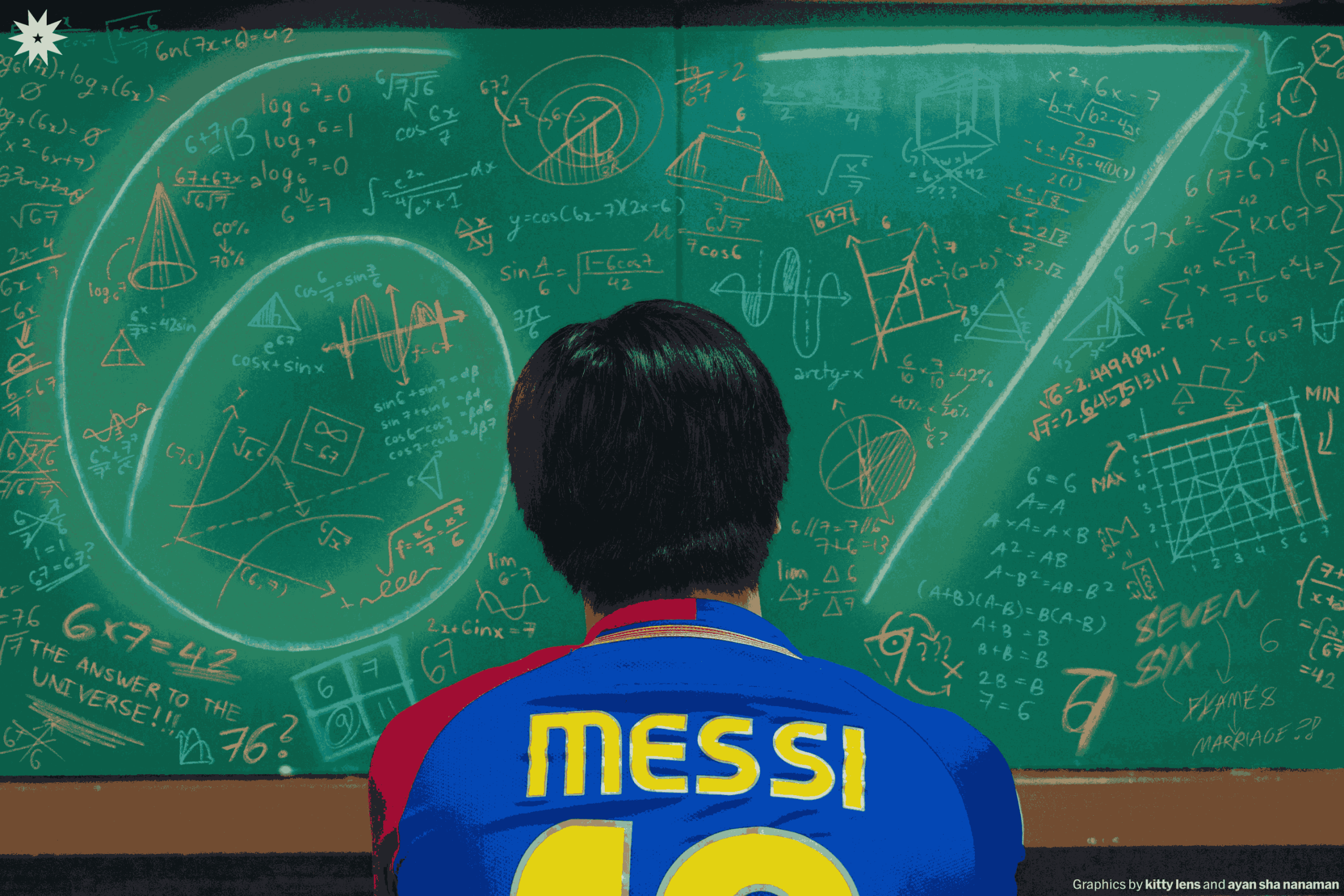
Since the axiomatic foundations laid by Euclid, mathematicians worldwide have endeavored to isolate a singular integer capable of balancing both peak factor stability and high-velocity cultural resonance. Historically, the positive integers 21 and 69 have been cited as primary candidates for the Universal Aura Constant (UAC). Yet this traditional heuristic fails to account for the natural Rizzonacci Sequence first observed in the later months of 2025. The prevailing mathematical model, which relied heavily on the Sigma Constant, has described a value of such magnitude that it has emerged in modern eras with far greater frequency than any numerical figure in recorded history. Against literally all odds, we find ourselves in a post-Euclidean reality where a new numerical constant is born. This paper seeks to solve for this x, proving the existence of what is not merely a number, but the terminal point of all neuro-linguistic entropy.
I. Rizzonacci sequence and the curvature ratio
As 67 began to emerge from the chaotic fog of post-2025 numerology, mathematicians, memelords, and curious onlookers alike quickly realized that traditional sequences can no longer account for its omnipotence. Thus, the Rizzonacci sequence was born, a sequence no longer defined by addition or recursion, but by social resonance and hand motion vectors.
Let Rn be the nth term of the Rizzonacci sequence, and Cn be the curvature ratio, a value that describes how well a number can warp the perceived coolness of a speaker. Initial research has shown that 67 is at the apex of this value, as it warps perception the most. Formally it may be written as:
C67 =
Here, Hn represents the hand motion coefficient, a newly discovered vector in our pioneering field of memetic physics. Observations indicate that 67 cannot be fully conveyed verbally; it requires the canonical hand motion for maximal effect.
If performed correctly, the motion creates auditory-linguistic resonance and magnetizes the phrase. If this action is not performed in a controlled environment, it can decrease the curvature ratio by up to 83 percent, causing observers to subconsciously replace 67 with 69 or 21, which are considered inferior aura constants.
The Rizzonacci sequence, then, is not just a series of numbers; it is a multi-sensory experience that has 67 as its singularity, a hand motion as its vector, and brainrot as its inevitable outcome.
II. The Linguistic Decay Limit: The Looksmaxx-Skibidi Theorem
One of the leading mathematical theories for explaining this mysterious universality is the Linguistic Decay Limit. It postulates that as the complexity of a conversation (C) approaches infinity, the communicative value of language undergoes a total topological brainrot, causing the probability (P) of a subject uttering the UAC to converge at a value far exceeding traditional probability bounds.
As first postulated by Dr. Looksmaxx and Dr. Skibidi of De La Salle University-Biringan in their groundbreaking paper, “Why Speak Many Word When Two Number Do Trick,” this phenomenon is expressed by the following limit:
where t represents time and P(C) accounts for the probability of verbal coherence. Note that in standard mathematics, the probability cannot exceed 1; however, within the recently described TikTokian Manifold, the number 67 is so esoterically heavy that it creates a localized gravitational pull on the tongue. This results in a probability overflow of 6,700 percent. Essentially, the subject does not merely choose to say “six-seven”—the number exerts a kinetic force upon the vocal cords, rendering any other response mathematically impossible.
III. The sixty-seventh law of aura-dynamics
The sixty-seventh law is the codification of something we’ve all secretly known, but been too afraid to say aloud: 67 is the most divine number in the universe. Any effort to integrate any other integer into conversation, mathematical equations, or existential musings instantly precipitates a wave of cringe so intense that the afflicted party is left questioning the nature of reality and their personal life choices.
In several studies, the number 67 has consistently been shown to distort the perception of any party exposed to it, rendering linear reasoning and probability no longer applicable. All efforts to supplant the number 67 with 21, 420, or even 69 have ended in spectacular failure, proving definitively that some numbers simply cannot be replicated.
Ultimately, our derivation of the UAC confirms that x = 67 is the denominator of reality. Any attempt to divide by a different integer results in a Cringe Error of such magnitude that the universe may lose all its aura entirely. We have rigorously looked into the abyss of real and imaginary numbers for the UAC until only one looked back and did a hand gesture.
We await our Nobel Prize in the mail shortly; kindly address it to Monsters University.
EDITOR’S NOTE: This work is part of The LaSallian’s annual spoof articles, which use satire to examine current events, issues, and culture. While it embraces humor, most articles still aim to inform and foster critical thinking.
Read all articles at spoof.thelasallian.com.